

 英语
英语 中文简体
中文简体



1. Why Grid Constraints Have Become a System-Level Planning Issue
Growth in data centers and EV charging networks, together with wider deployment of distributed energy resources, is creating new requirements for load visibility, forecasting, and operational flexibility.
On 18 June 2026, FERC issued tailored show-cause orders to the six regional grid operators under its jurisdiction. The related proceedings also require their relevant transmission owners to justify existing tariff provisions or support proposed reforms governing large-load integration.
These proceedings address tariff clarity, study processes, cost allocation, co-located generation and load arrangements, and firm, non-firm and other flexible transmission-service options. They do not establish a single nationwide metering specification for data centers or other large loads.
This reflects a broader shift: grid planning must consider not only total energy consumption, but also where, when, and how electrical demand behaves across different system conditions.
2. From Aggregate Energy Data to Time-Dependent Load Representation
Electricity systems have always considered demand, peak loading, and operational constraints. What is changing is the level of temporal and spatial detail required for planning and operations.
Traditional billing and facility-level monitoring practices often emphasized cumulative energy and relatively stable demand assumptions.
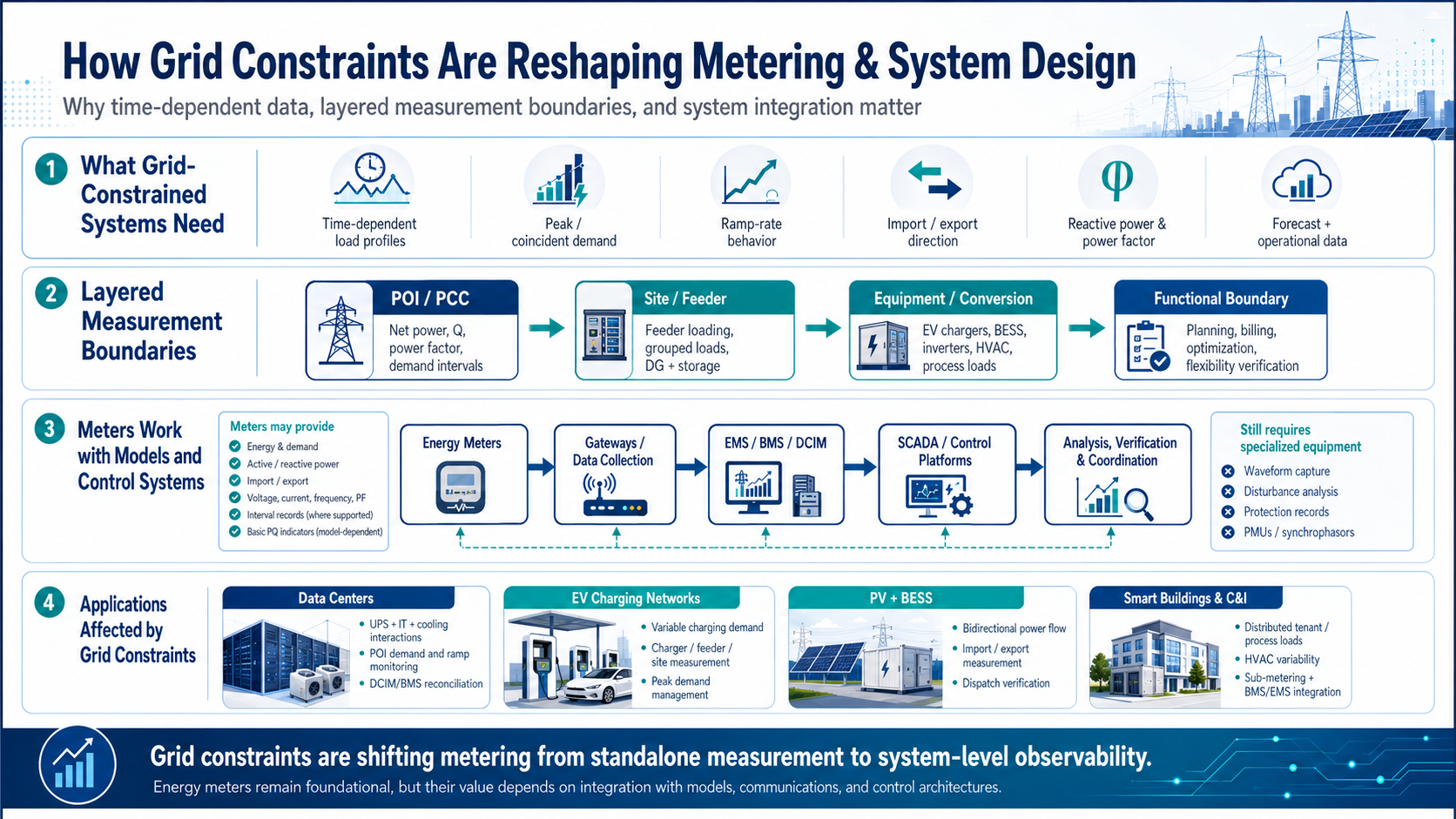
Modern grid-constrained applications increasingly require:
- Time-dependent load profiles
- Peak and coincident-demand analysis
- Ramp-rate characteristics
- Import and export direction
- Reactive-power and power-factor behavior
- Location-specific measurement boundaries
- Forecast, commissioning, and operational data
- Alignment between measured data and engineering models
Grid operators and system planners must evaluate not only how much electricity is consumed, but also how demand evolves over time and across the network.
3. Why Meter Data Must Be Combined with Models and Control-System Data
Energy meters remain a foundational measurement source, but modern power systems cannot rely on meter data alone.
System-level visibility typically combines:
- Utility-facing POI measurements
- Distributed sub-metering
- Engineering and dynamic-system models
- EMS, BMS, DCIM and other management or control platforms
- SCADA and operational telemetry
- Power-quality and event-recording devices
- Commissioning and validation datasets
Communication-enabled and multi-function meters can serve as part of a distributed measurement infrastructure.
Depending on model and configuration, meters may provide:
- Energy and demand values
- Active and reactive power
- Import/export registers
- Interval records (where supported)
- Voltage, current, frequency, power factor
- Basic power-quality indicators (model-dependent)
- Communication outputs for gateways or control platforms
However, detailed waveform capture, disturbance analysis, protection records, and synchronized phasor data typically require specialized equipment.
Meter data can serve as input for EMS, BMS, aggregators, or control platforms to support analysis, verification, and coordination of load-shifting or demand-response strategies. The meter itself does not determine control actions.
4. Measurement Boundaries Are Becoming More Layered Across Applications
Modern energy systems require multiple layers of measurement boundaries depending on the use case.
4.1 Utility-Facing Boundaries (POI / PCC)
At the grid interface, relevant measurements may include:
- Net active power
- Reactive power
- Voltage and frequency behavior
- Power factor
- Import/export direction
- Ramp-rate characteristics
- Demand intervals
This layer supports grid planning, congestion analysis, and interconnection studies.
4.2 Site and Feeder-Level Boundaries
Feeder and site-level visibility supports system aggregation and local balancing:
- Feeder loading conditions
- Coincident demand across loads
- Distributed generation output
- Storage charging and discharging
- Load grouping and segmentation
4.3 Equipment and Conversion Boundaries
Different systems may require measurement around specific equipment:
- EV chargers
- Battery energy storage systems (BESS)
- Inverters and power electronics
- HVAC and motor-driven loads
- Industrial equipment
- Tenant or process-level loads
4.4 Functional Boundaries (Operational vs Billing vs Flexibility)
Measurement boundaries depend on application intent:
- Utility planning and interconnection studies
- Internal energy management
- Billing and cost allocation
- Efficiency optimization
- Demand-response verification
- Flexibility assessment and settlement
Boundaries are therefore layered rather than singular.
5. Why Interval Data and Time Alignment Are Increasingly Important
For applications involving peak demand, ramp rates or operational flexibility, time resolution can be as important as total energy.
Different stages of system lifecycle require different levels of data granularity:
- Planning: forecast profiles and load assumptions
- Commissioning: verification of as-built performance
- Operations: interval or near-real-time monitoring where required
Key temporal elements include:
- Demand intervals defined by utilities or study processes
- Polling intervals from meters and gateways
- Timestamp synchronization across systems
- Data aggregation and reporting logic
Without consistent time alignment, system-level analysis of load behavior becomes unreliable.
6. Flexibility: From Technical Capability to Conditional System Value
Grid constraints are increasing the operational importance of flexibility in selected markets and contractual frameworks.
Flexibility refers to the ability of a load, storage system, or distributed resource to modify its power profile within defined technical and operational limits.
A usable flexibility capability may require:
- Measurable available capacity
- Controllable load or storage resources
- Defined operational constraints
- Communication and control interfaces
- Response time and duration requirements
- Baseline methodology
- Recovery or rebound behavior
- Measurement and verification procedures
- Contractual or market eligibility where applicable
- Settlement rules where applicable
Measurement is necessary, but not sufficient by itself.
In applicable programs or agreements, flexibility may have operational and, in some cases, commercial value depending on market structure and regulatory design.
7. How Grid Constraints Change System Design Requirements
System design must now address both electrical and data architecture requirements.
Key design dimensions include:
- Distributed metering architectures
- Communication topologies (field, gateway, cloud)
- EMS, BMS, DCIM and other management or control platforms
- Edge data processing and aggregation
- Data retention and traceability
- Cybersecurity and access control
- Power-quality and event monitoring integration
- Model validation and calibration workflows
- Specialized measurement equipment for PQ and disturbances
System design is therefore a combined consideration of electrical topology, protection, safety, reliability and data observability.
8. How Grid Constraints Affect Different Applications
8.1 Data Centers
- High-density and continuous load profiles
- UPS, IT, and cooling subsystem interactions
- POI demand and ramp-rate monitoring, with control capability where required
- Backup generation and storage integration
- DCIM, BMS, and utility-data reconciliation
8.2 EV Charging Networks
- Highly variable and correlated charging demand
- Charger-, feeder-, and site-level measurement
- AC/DC boundary considerations
- Session-based energy tracking
- Peak demand and congestion management
- Integration with charging controllers and EMS platforms
8.3 PV and Battery Energy Storage Systems
- Bidirectional power flow
- Inverter and battery system boundaries
- Import/export measurement requirements
- Net-load calculation at site level
- Dispatch verification and performance tracking
8.4 Smart Buildings and C&I Facilities
- Distributed tenant or process loads
- HVAC and motor-driven systems
- Occupancy-driven variability
- Sub-metering for allocation and optimization
- BMS/EMS integration for efficiency control
9. Metering and Data Requirements Across Grid-Constrained Applications
Across these applications, key measurement considerations include:
- Intended use of the data, such as planning, operations, billing or flexibility verification
- Electrical-boundary definition at the POI, feeder, site or equipment level
- AC or DC system architecture
- Direct-connected, CT-operated, shunt-based or compatible sensor-based measurement
- Demand and interval calculation methods
- Communication interfaces and protocols, such as RS485 and Modbus
- Data synchronization with higher-level systems
- Import and export tracking
- Event and power-quality requirements
- Data-retention and validation requirements
Energy meters provide a foundational electrical-data layer, but they do not replace:
- Power-quality analyzers
- Protection relays and their event or fault records
- Disturbance recording equipment
- PMUs (phasor measurement units)
- SCADA systems
- Engineering and dynamic system models
10. What This Means for Meter Manufacturers
Meter manufacturers are increasingly evaluated not only on hardware performance, but also on integration capability.
Key expectations may include:
- Clear documentation of supported measurement configurations and intended measurement boundaries
- Consistent register mapping and technical documentation
- Communication-interface compatibility
- Sample testing and integration-validation support
- Integration support for gateways or controllers
Meters remain measurement devices, but they are increasingly part of larger system architectures rather than standalone tools.
11. How YTL Supports Grid-Constrained Applications
Zhejiang Yongtailong Electronic Co., Ltd. (YTL) provides AC energy-metering products and selected DC metering products for EV charging, PV and energy-storage, data-center, building and C&I monitoring applications, depending on model and project architecture.
YTL can support:
- Initial meter model selection
- Voltage, current, and CT-range review
- Direct-connected, CT-operated, shunt-based or compatible sensor-based measurement evaluation
- Communication-interface confirmation
- Register-map review
- Sample testing and integration-validation support
- Meter-to-gateway or controller integration review
- Initial technical discussion of customer-proposed measurement points and boundaries
Product capabilities vary by model, hardware, firmware, sensing method, communication interface and project configuration.
YTL meters support the measurement and data-acquisition layer. System-level studies, control design, dynamic modeling, SCADA implementation, grid-interconnection approval and flexibility-program qualification remain the responsibilities of the relevant designers, consultants, system integrators, utilities and project stakeholders.
12. Conclusion
Grid constraints are reshaping how energy systems are measured, modeled, and operated.
Rather than focusing solely on energy consumption, modern systems must account for load behavior, temporal variation, electrical boundaries, and system-level interactions.
Energy meters remain a foundational component of this ecosystem, but their value increasingly depends on how they integrate with models, communication systems, and control architectures.
References
- Federal Energy Regulatory Commission, “FERC Launches Aggressive Targeted Action to Speed Large Load Integration,” June 18, 2026.
- Federal Energy Regulatory Commission, “Fact Sheet | FERC Takes Action to Supercharge America’s Grid for Efficiency, Reliability, and a Bold Energy Future,” June 18, 2026.
- North American Electric Reliability Corporation, “Reliability Guideline: Risk Mitigation for Emerging Large Loads,” April 2026.